
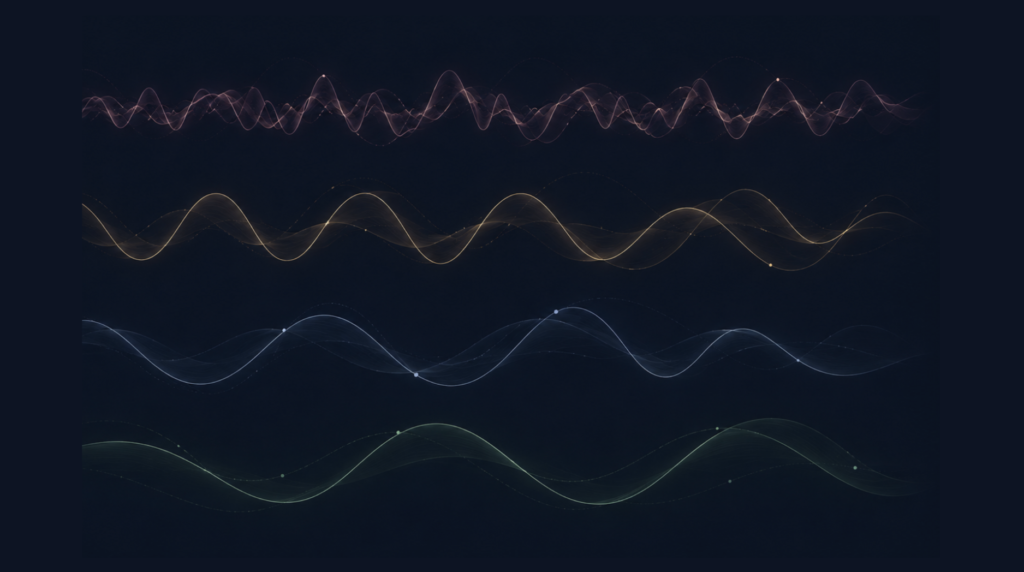
A qEEG brain map provides a snapshot of your brain’s electrical activity.
EEG – electroencephalography – is more than a century old and remains one of neuroscience’s longest-standing tools for studying human brain activity.
Your brain contains billions of neurons, cells that communicate through electrical and chemical signals. When large groups of neurons receive signals in a coordinated way, their combined activity can be detected by non-invasive sensors at the scalp.
Some of this activity forms rhythmic patterns we call brainwaves.
What a brain map measures
qEEG – quantitative EEG – takes this analysis a step further.
Under 3 different conditions – eyes open, eyes closed, and a working memory task – a qEEG measures which brainwaves are present, where they appear, how strong they are, and how activity recorded at different locations relates to one another.
An established body of research helps scientists interpret those measurements and explore what they might mean for the individual.
At Santaia, we use this information alongside your lived experience to explore four areas:
- Stress + reactivity
- Emotional regulation
- Cognitive function + focus
- Sleep + recovery
Comparing your map with a normative database – a reference set of brain recordings from people of a similar age and the same sex – adds context, helping us identify which patterns fall within the expected range and which may warrant a closer look.
What the patterns can tell us
No brainwave is inherently good or bad. What matters is where it appears and under what conditions.
For example, slower brain activity can reflect a relaxed, inwardly focused state. But too much in the frontal regions when the brain is under demand can be associated with mental fatigue, low alertness, or brain fog.
Likewise, faster activity helps support alertness, focus, and active thinking, but it can also accompany stress and anxious rumination.
The presence of a brainwave does not, by itself, prove dysregulation. It gives us something to investigate alongside the person’s experience and recording conditions.
qEEG isn’t new, but where we’re taking it is
Over many years, we’ve had the opportunity to map over 1,000 brains across high performers, athletes, and people navigating brain injury, chronic stress, mental-health challenges, and addiction.
For many people, brain function isn’t something they look at until there is a clinical reason to.
By bringing brain measurement into the environments where life actually happens, we can explore how measured patterns relate to our experiences of work, relationships, and daily habits.
From insight to training
A brain map is the starting point. We use these patterns as information, rather than as labels, diagnoses, or definitive evidence about who you are.
From there, we combine measurement with nervous-system education and evidence-informed practices designed to help your system practice new ways of responding, focusing, and recovering.
Reassessment helps us explore what shifted, so training can be personalized and adapted to your brain and body data.
References
- One hundred years of EEG for brain and behaviour research (2024)
- Quantitative Electroencephalogram Standardization: A Sex- and Age-Differentiated Normative Database (2021)
- The influence of mental fatigue on brain activity: Evidence from a systematic review with meta-analyses (2020)
- EEG power spectral measures of cognitive workload: A meta-analysis (2022)
- The neural correlates of psychosocial stress: A systematic review and meta-analysis of spectral analysis EEG studies (2022)
- Electrophysiological correlates of anxious rumination (2009)