
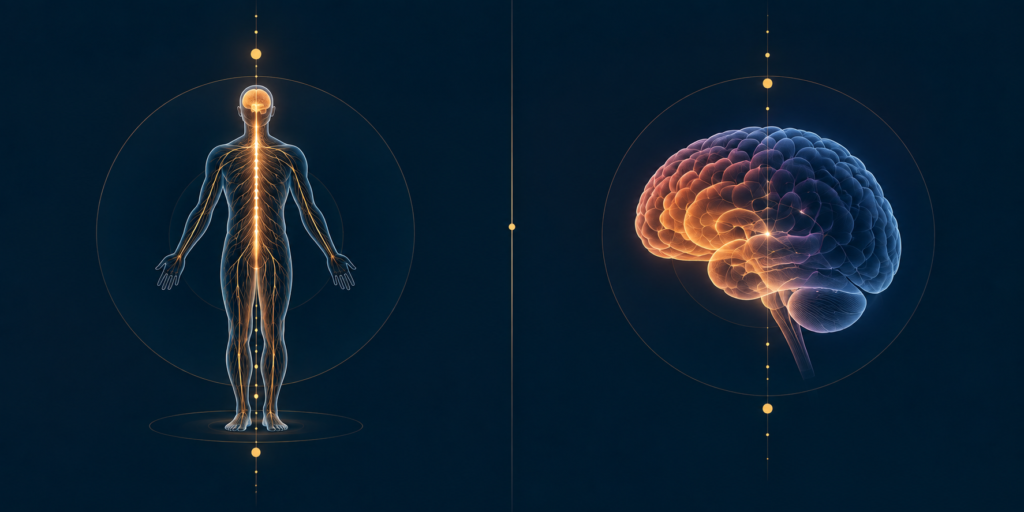
With Santaia, you get a glimpse into something most people rarely get to see: how your nervous system is functioning.
The nervous system is your brain-body communication network. It helps shape how you think, feel, perform, and recover.
Its activity can influence:
- What captures your attention
- How you interpret an experience and what feels true
- How you respond under pressure
- How safe or threatening you perceive a situation to be
- How easily you unwind after stress activation
Regulation means being able to shift
A common misconception is that a regulated nervous system is always calm or relaxed.
Regulation is the capacity to shift between activation and recovery – to adapt to what each moment of life requires.
Your system mobilizes when needed: to meet a challenge, engage with something meaningful, or respond to a demand.
Then, as that demand passes, it transitions toward rest and recovery, restoring energy and resources.
When you have that flexibility, you may find:
- Your perspective feels broader
- It feels easier to consider a different perspective
- Emotions can be felt without becoming overwhelming
- You have more room to consider options and possibilities
When your system struggles to shift
Under prolonged stress, that flexibility can become harder to access.
When dysregulated, you may notice:
- Attention narrowing around a concern
- Thoughts feeling rigid or urgent
- Emotions becoming harder to navigate
- Difficulty settling after the pressure has passed
Building nervous system capacity
Building that capacity to shift is central to Santaia’s approach to nervous-system training.
It matters for both high performance and well-being: being able to engage with what challenges you, recover afterward, and have more capacity for the life you want to live.
References
Interaction between cognition, emotion, and the autonomic nervous system (2013)
Neurobiology and systems biology of stress resilience (2024)
Effects of chronic stress on cognitive function—From neurobiology to intervention (2024)