

We’ve all been caught in a downward spiral.
After the end of a relationship, a financial mistake, or a project that didn’t work, it’s natural to experience disappointment, regret, and guilt.
These experiences can draw attention toward what happened: what you lost, what you wish you’d done differently, or what needs repair.
They leave something concrete to address.
But repeated self-criticism can evolve into shame: the problem begins to feel like who you are rather than something you can work through.
And it makes the path forward harder to see.
When the mind shifts focus to the self, it can feel permanent.
The future begins to feel predetermined:
- “This will never change.”
- “Nothing I do matters.”
- “I’ve tried everything.”
- “There isn’t another way.”
Research on rumination shows that it can intensify negative thinking, interfere with problem-solving, and make constructive action harder.
Perceived options narrow because they become harder to recognize and believe in.
We may then withdraw, isolate, or stop doing things that bring support, enjoyment, or a sense of progress.
That leaves fewer opportunities to experience something different, and the original conclusion can feel even more convincing.
Nothing changes begins to feel like proof that nothing can.
An upward spiral can begin when another possibility starts to feel available
Psychologist Barbara Fredrickson’s broaden-and-build theory proposes that positive emotions – such as curiosity, joy, and appreciation – can broaden the range of thoughts and actions available to us.
You can recruit resources, building the capacity to imagine a different outcome, consider another approach, or see a next step where there wasn’t one before.
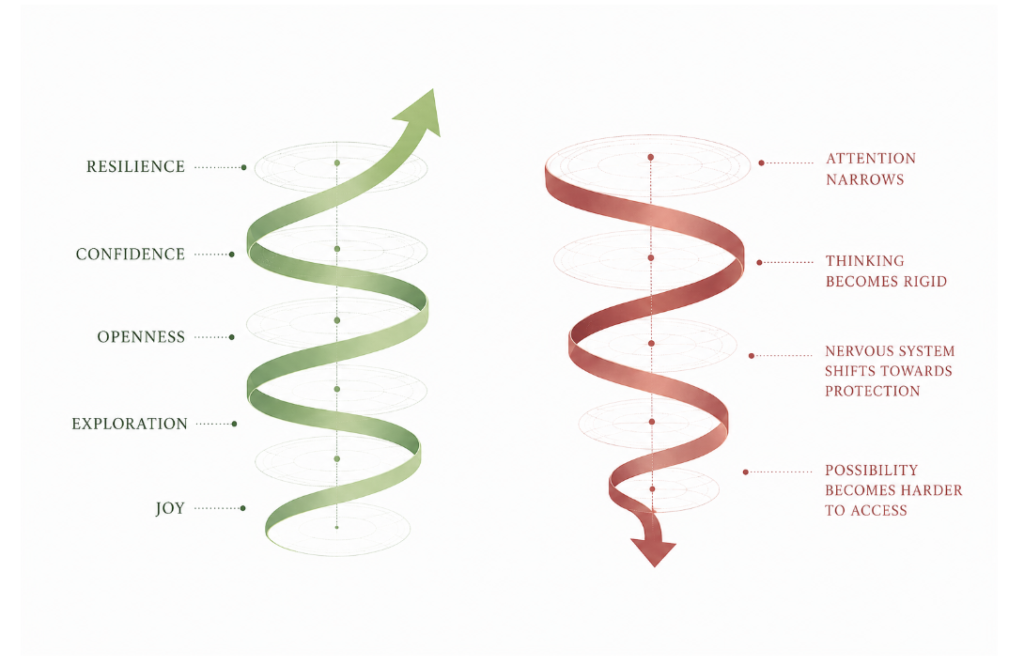
Psychologist C.R. Snyder’s hope theory describes what helps us move towards possibility:
- Agency: I can take a step towards something that matters to me
- Pathways: If this route is blocked, I can look for another
A 2023 meta-analysis found that both were associated with lower depression and anxiety across studies.
Together, these frameworks allow you to recognize the spiral and influence its direction.
Start with a point of stability
When you’re overwhelmed, it’s difficult to generate blind optimism or force positive thinking.
Instead, start with a point of stability.
Take a phone-free walk. Eat a meal. Listen to a few minutes of music you enjoy. Have a meaningful conversation.
Resource your nervous system and consider:
- What is still within my control?
- What is one move I can make from here?
Asking these questions helps restore a sense of agency, opening up possibilities that felt out of reach.
Choose something manageable in the next 30 minutes: one email, application, conversation, or moment of showing up differently.
Then give yourself permission to pause.
You don’t have to solve the whole situation in one sitting.
And next time shame shows up, try to remember: You are not the mistake.
You are a human being having an experience.
What happened may need attention, accountability, or change. It doesn’t have to become the whole story of who you are.
References
- Moral Emotions and Moral Behavior (2007)
- Rethinking Rumination (2008)
- The Broaden-and-Build Theory of Positive Emotions (2004)
- Hope Theory: Rainbows in the Mind (2002)
- The Relationships Between the Hope Dimensions of Agency Thinking and Pathways Thinking With Depression and Anxiety: A Meta-Analysis (2023)